Key Takeaways
- Doghobble Wine Farm grows over 170 pawpaw trees, including 12 elite cultivars bred by Neal Peterson, the man who spent his life rescuing this fruit from obscurity.
- The pawpaw is the largest edible fruit native to North America: creamy, tropical-tasting, and once beloved by Native tribes, George Washington, Thomas Jefferson, and Lewis and Clark.
- It evolved to be eaten by Ice Age megafauna. When those animals went extinct, the pawpaw survived by cloning itself, which is why you find it in patches, not scattered trees.
- It vanished from stores because ripe fruit lasts only days. It never left the woods; it left our memory.
- On Sunday, September 6, we’re opening the orchard: tasting, grower panel, and tour. $10, limited to 50 guests.
There’s a fruit growing on this farm that evolved to be eaten by animals that no longer exist.
That is not a figure of speech. The pawpaw is old (fossil records for its genus reach back tens of millions of years) and it developed its large, soft, sweet fruit to be swallowed whole by the giant mammals of the American Ice Age. Mastodons. Giant ground sloths. Creatures that would carry the seeds miles and leave them somewhere new.
Then those animals disappeared. And the pawpaw, left without a ride, did something remarkable: it started cloning itself, sending up root suckers to form dense groves. That’s why, to this day, you don’t find a lone pawpaw tree in the Georgia woods. You find a patch, a single stubborn organism that has been waiting ten thousand years for a mastodon that isn’t coming.
We planted 170 of them at Doghobble. Here’s why.
America’s Forgotten Fruit
The pawpaw (Asimina triloba) is the largest edible fruit native to North America, and its family tree is genuinely strange. Nearly all of its botanical relatives are tropical: cherimoya, sugar apple, soursop, the custard fruits of Central and South America. The pawpaw is the family’s one northern wanderer, growing wild across 26 states, from the Deep South up into Michigan and southern Ontario, and right here in the shaded creek bottoms of North Georgia.
Taste one and the family resemblance is unmistakable. The flesh is golden-orange, custard-smooth, with flavors that reach toward banana, mango, papaya, and pineapple all at once, and still land somewhere entirely its own. It is a tropical experience from a tree that has grown in these mountains since long before anyone thought to plant a vineyard here.
And people knew it. Native tribes harvested pawpaws for millennia. The first written record came in 1541, from a member of Hernando de Soto’s expedition through the American South. The Europeans called it “pawpaw” because it reminded them of papaya. George Washington took his chilled, for dessert. Thomas Jefferson planted the trees at Monticello and sent seeds to Paris. The Lewis and Clark journals record the expedition living on pawpaws and biscuits when rations ran out on the way home. Daniel Boone ate them. Mark Twain loved them.
So what happened?
The Fruit That Refused to Cooperate
Industrial agriculture asked one question of every fruit: can you ship?
The pawpaw could not. A ripe pawpaw lasts three, maybe four days at room temperature. It bruises if you look at it wrong. It ripens suddenly, drops on its own schedule, and refuses to sit patiently under fluorescent lights waiting to be purchased. While blueberries and pecans, fellow American natives, became supermarket staples, the pawpaw simply washed out of commerce.
But it never went anywhere. The trees are still out there, still fruiting every September along Georgia’s creeks. The pawpaw didn’t disappear from the land. It disappeared from the table.
The Man Who Brought It Back
If pawpaws are having a comeback, one person deserves most of the credit: Neal Peterson.
Peterson, a Quaker plant breeder, tasted a wild pawpaw in a university arboretum and never really recovered from it. He asked a question nobody had bothered to ask: if this fruit had been bred and cultivated for two centuries the way apples and peaches were, what would it taste like today?
He spent decades finding out. He scoured abandoned orchards, dug through courthouse records, and tasted thousands of wild fruits hunting for the best genetics. At one point he cashed out his retirement savings to plant 3,000 grafted trees in West Virginia. A drought killed all but 50. He started over.
The work was slow in a way that would have defeated almost anyone. A pawpaw seedling needs seven or eight years before it fruits at all, and you need three seasons of fruit to judge it fairly, roughly a decade to evaluate a single generation. No commercial operation would fund that on an unproven fruit. It took a fanatic.
What came out of that obsession are the finest pawpaws anyone has ever eaten: smooth, rich, light on seeds, and dependable. Most breeders name varieties after themselves. Peterson named his after rivers, and specifically rivers carrying Native American names, because Native Americans were the original pawpaw people: Potomac. Shenandoah. Susquehanna. Rappahannock. Allegheny. Wabash.
Twelve of Peterson’s elite cultivars are now rooted in the hills of Doghobble Wine Farm. We owe a great deal of what we do here to his life’s work.
Why a Wine Farm Grows Pawpaws
Our farm is named for the doghobble (Leucothoe), a native Appalachian shrub most people walk past without a second look. That’s not an accident. Doghobble exists to revive and celebrate great American plant traditions: heritage muscadine grapes, native wine varieties like Norton, and the forgotten fruits and botanical curiosities that belong to this soil.
The pawpaw is the purest expression of that idea we’ve found.
It also fits how we farm. Pawpaws need little intervention once established, with no spraying required. Their broad, lush leaves shade out weeds on their own. Their blossoms turn deep maroon and give off a faintly fetid odor, because they’re courting flies and beetles rather than honeybees. And because the flowers mature their female parts before their male parts, a pawpaw can’t pollinate itself, which is exactly why an orchard needs multiple varieties, and why we planted twelve.
Like the sheep in our vineyard rows and the seasonal menu at our farm table, the orchard comes down to one belief: the best things in a glass or on a plate come from this land, this soil, this season.
The pawpaw’s season is right now.
Come Taste One: Georgia PawPaw Day, Sunday, September 6
The pawpaw ripens for only a few short weeks, from late August through September. It cannot be rushed, stored, or shipped to you. If you want to taste America’s forgotten fruit, you have to visit the farm, so we’re making that easy.
On Sunday, September 6, from 2 to 5 PM, Doghobble Wine Farm hosts an afternoon celebrating the pawpaw in Georgia:
2:00 PM, PawPaw Tasting. Ripe Georgia pawpaws at the absolute peak of the season. 3:00 PM, Panel Conversation. I’ll be joined by two of Georgia’s leading pawpaw growers, Blake Price, Founder & Owner of Athens Orchards, and Blair Housey, Founder & Owner of Etowah Meadery, for a conversation about growing, foraging, and the future of native fruit in the South. 4:00 to 5:00 PM, More Tasting & Orchard Tour. Walk all 170 trees and see the Peterson varieties for yourself.
Wine and pawpaw mead will be available for purchase throughout the afternoon, along with wood-fired pizza and food from the tasting room. Tickets are $10 for the pawpaw tasting, and we’re limiting the afternoon to 50 guests. Reservations strongly recommended.
Every September we shake the trees, dodge the falling fruit, and taste for ripeness. It isn’t only farming. It’s restoration, a homecoming for a fruit, a flavor, and a deeper connection to this land.
Visit Doghobble Wine Farm
Doghobble Wine Farm is located at 10 Roy Grindle Road, Dahlonega, GA 30533, on the Dahlonega Wine Highway, about 90 minutes north of Atlanta and 10 minutes from historic downtown Dahlonega. We’re open Sunday through Thursday from 12 to 6pm and Friday and Saturday from 12 to 7pm. For groups of 6 or more, call ahead at (470) 310-0491 or email hello@doghobblevineyard.com.
The pawpaw is the largest edible fruit native to North America, with golden-orange, custard-like flesh and a flavor often compared to banana, mango, papaya, and pineapple. It grows wild across 26 states, including throughout Georgia, and belongs to a botanical family that is otherwise almost entirely tropical.
Over 170, including 12 elite cultivars bred by Neal Peterson, among them Shenandoah, Rappahannock, Potomac, Susquehanna, Allegheny, and NC-1.
Ripe pawpaws last only about three to four days at room temperature and bruise easily, so they were never commercially viable. Unlike blueberries and pecans, the pawpaw never made the leap into large-scale agriculture, which is why tasting one usually means visiting a grower during the short season.
Neal Peterson is a West Virginia plant breeder who spent decades searching out and improving pawpaw genetics, effectively creating the modern cultivated pawpaw. He named his varieties after rivers bearing Native American names rather than after himself. His trees are now licensed to nurseries across North America and overseas, and twelve of his cultivars grow at Doghobble.
You can, but most enthusiasts advise against it. Heat flattens the pawpaw’s distinctive tropical zing and leaves it tasting closer to ordinary banana. The pulp freezes beautifully, though, and pawpaw ice cream is a favorite for good reason.
At Georgia PawPaw Day on Sunday, September 6, from 2 to 5 PM. The afternoon includes a guided pawpaw tasting, a panel with Georgia’s leading pawpaw growers, and a walking tour of the orchard. Tickets are $10 and limited to 50 guests.
No. Only the flesh should be eaten. The seeds and skin should never be consumed.
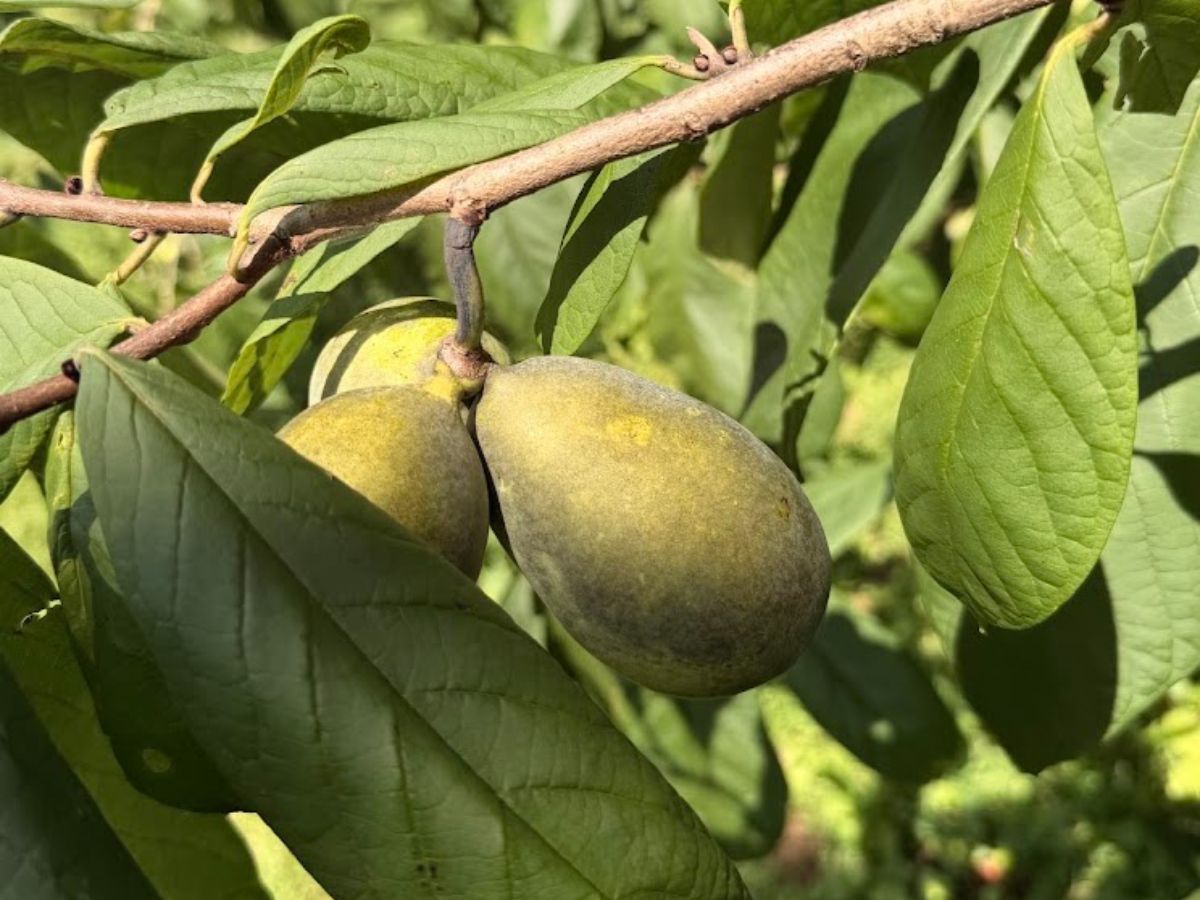
Table of contents
You may also like
 Published On: April 2, 2026
If you're planning a wine tasting trip through North Georgia or Dahlonega, there's one question that comes up almost as [...]
 Published On: April 1, 2026
In 2018, the federal government officially recognized a new American Viticulture Area in Georgia, the Dahlonega Plateau AVA, covering the [...]
 Published On: April 1, 2026
From Locals Who Live Here Just over an hour north of Atlanta on GA-400, less time than it takes to [...]
 Published On: March 19, 2026
A conversation about cooking with heart, feeding sheep arugula, and why the chef's board is her favorite thing on the [...]
 Published On: February 26, 2026
There is something quietly magical about a vineyard in winter. Most people think of wine country as a summer and [...]
 Published On: February 16, 2026
If you've visited wineries in California or Napa, you might wonder: Where's the Cabernet Sauvignon? Why so much Norton and [...]
 Published On: February 12, 2026
Nestled in the foothills of the Blue Ridge Mountains, Dahlonega has earned its reputation as the heart of Georgia’s wine [...]